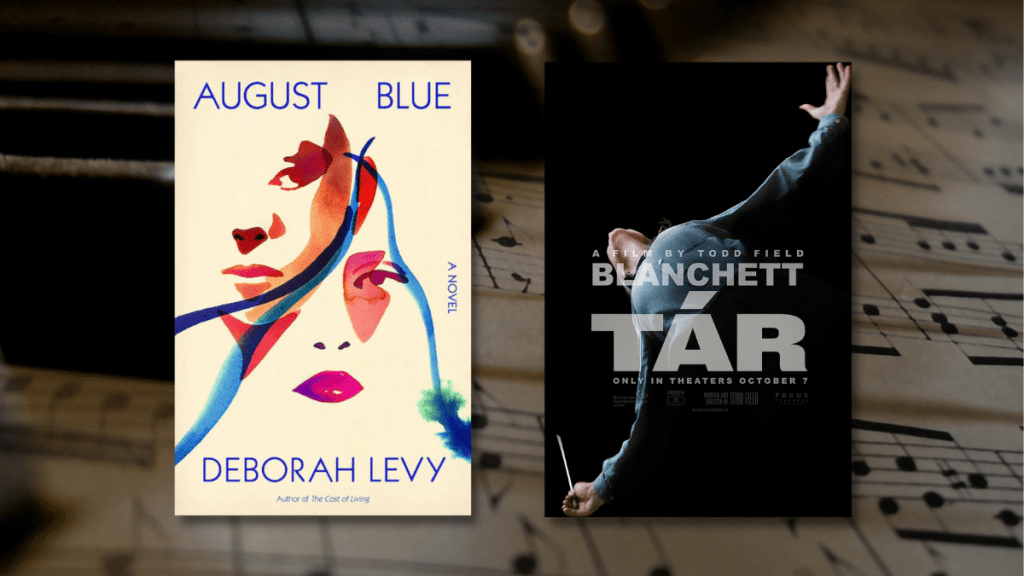
While the current double feature of choice is Barbenheimer (the two films Barbie and Oppenheimer) I’m going to suggest another double bill and this one is a book and a movie. Both August Blue, written by Deborah Levy and Tár, directed by Todd Field, offer depictions of incredibly complicated and tormented women, who have reached the pinnacle of success in the patriarchal world that is Classical Music only to have hefty challenges come their way.
Deborah Levy is a celebrated British author, who has been short-listed three times for the Booker Prize. August Blue is her latest novel and the meaning of the title is explained to you as you make your way through the book. The main character is Elsa M. Anderson, a former child prodigy and now famous pianist. We quickly learn that while Elsa was at the peak of success, she had an unfortunate episode during a performance in Vienna. In attempting to tackle Rachmaninov’s Piano Concerto No. 2, Elsa only made it part way through before distractedly going off book and then abruptly leaving the stage. Her breakdown mid-performance becomes known the world over.
In the midst of this drama, the COVID-19 pandemic hits, and Elsa decides to keep her foot in the musical door by teaching private lessons to wealthy young students throughout Europe. We first meet her in Athens, Greece, as she is on her way to teach a 13-year-old named Marcus. Mid-travel to Marcus, who is living on the island of Poros, Elsa sees her doppelgänger, a woman who looks like her and who is even dressed like her, when shopping at a Greek Market. She continues to see this woman throughout the book in what ends up being a literary technique used for Elsa to explore of her true identity. The story also travels back into Elsa’s past as she revisits her own history and the impact of being adopted at the age of six by a musical genius/teacher who crafted her into a piano virtuoso.
Levy’s writing style has the amazing ability of being both sparse yet incredibly specific. This is not a padded book with lots of excess language, all of her words are chosen carefully. I love Levy’s writing so much for the distinct imagery she creates and the details that she does provide, for instance, specific locations, streets and even sculptures. I found myself with a computer by my side looking up information on all the places she mentions. I had great fun travelling virtually through Europe, to Greece, France, England and Italy, as I embraced her story. When reading this book, it also feels like she provides you with a soundtrack as she mentions the particular musical scores that Elsa plays or works on with her students. You might enjoy listening to the music as you delve even deeper into the tale. August Blue would translate very effectively to the big screen and as I was reading it, I couldn’t help but think of the film Tár, which I find to be a sister work of art.
Tár is a fascinating psychological drama starring Cate Blanchett as Lydia Tár, an internationally renowned “maestro.” Tár is chief conductor of a celebrated German symphony, who also travels the world giving guest lectures at the likes of Juilliard having reached the apex in the Classical Music world. Blanchett gives a mesmerizing performance as Tár; watching her conduct and discuss music at speaking engagements and lectures is thrillingly hypnotic. Her character is intelligent, aflush with in-depth musical knowledge and extremely confident in all of her skills; however, this confidence—or perhaps ego—may be her tragic flaw. Without giving too much away, the film explores the perils of power in a grand, surrealist portrayal. After watching this movie, you may want to seek out a review or two, or even have a second viewing. Tár leaves you with a lot to contemplate!
 Check it out